
Why Ghana Is Still Failing To Resist The Oppressor's Rule
- Bella Frimpong

- Mar 7, 2021
- 4 min read
Updated: Mar 8, 2021
As many Ghanaians celebrate 64 years of independence from British colonial rule this weekend, I struggle to reconcile the depiction of Ghana as a liberated country with the reality of state sanctioned violence and oppression perpetuated against LGBTQI citizens.
Over the last few weeks, the subject of LGBTQI rights in Ghana gained traction in light of the LGBTQ Right Ghana advocacy centre opening and then being shut down, as well as the vetting of elected MPs following the December 2020 elections. What should have simply been a process for MPs to present their views on various areas of policy, has now developed into a nationwide homophobic and transphobic tirade. Witnessing the unfolding crack down on queer people's livelihoods and civil liberties, the scapegoting and bigotry aimed at this community has been painful. The government, religious leaders and the media have all played an instrumental role in inciting violence and oppressing queer people; as all three necessarily continue in their performative heralding of Ghana as free country, we must question who is the freedom limited to?
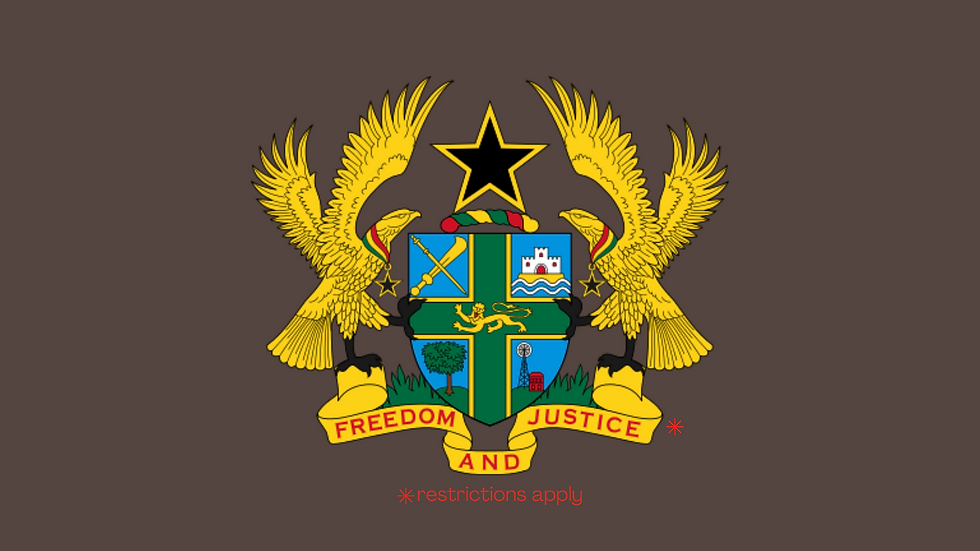
The powerful words inscribed in the Ghanaian coat of arms at this point, are meaningless.
Freedom & Justice
Queer Ghanaians have been excluded from experiencing both freedom and justice for many years. Human Rights Watch’s 2018 report documenting the lives of LGBTQI Ghanaian individuals is a sobering reminder of the horrific treatment members of the community are subjected to- at the hands of family, society and state sanctioned authorities. While there are no explicit laws criminalizing homosexuality in Ghana, there are equally no constitutional protections of human rights and freedoms for LGBTQI people:
“Every person in Ghana, whatever his race, place of origin, political opinion, colour, religion, creed or gender shall be entitled to the fundamental human rights and freedoms of the individual contained in this Chapter but subject to respect for the rights and freedoms of others and for the public interest.”
There is a distinct exclusion of sexual orientation as a protected characteristic. When we talk about freedom and justice and when we paint Ghana as a bastion of peace or even describe it as home, who is excluded from the narrative?
Despite the lack of criminalisation of LGBTQI identities in Ghana, the state and individuals continue to incite violence against queer people, quoting section 104 of the country’s penal code (alongside religion and tradition), which criminalises consensual ‘unnatural carnal knowledge’. This outdated and convoluted legislation is a British export: a relic of Ghana’s colonial history which we still have not gotten rid of. This terminology has been interpreted to mean same- sex activity, and has been cited as the legal grounds for discrimination against queer people in Ghana. Despite the fact that this interpretation truly has no basis, Ghanaian society has internalised this senseless bigotry, even when colonizers have gotten rid of it themselves.
How then, do we in good faith sing the lines “help us to resist the oppressor’s rule”, in the national anthem, when the oppressor’s legislations are still alive and well in the country? How do we utter these words when we still observe and implement colonial rules against our own? The dissonance of singing these lines while actively perpetuating harm against the LGBTQI community is as jarring as the president’s silent but complicit role in this situation.
I, like all Ghanaian diaspora, have a role to play. I will not amplify the image of Ghana as a peaceful country and I refuse to contribute in painting it as a welcoming home, when it deprives some of their identities and humanity. The azonto warriors need to channel their energy into a different fight: one for equality for all. The rose-tinted view of Ghana so many in the diaspora have, needs to be dismantled for the sake of those actually living in the country. Before our annual display of performative nationalism, we truly need to question this so-called independence.
It is also a cop out to claim we are unable to support because we do not live in Ghana. Solidarity transcends borders; applying pressure on our local governments to raise the profile of this issue is one way. Being vocal in our challenge of homophobia within our communities is also another. Donating to LGBT Rights Ghana and similar organisations is another way to action solidarity. Most importantly, amplifying the voices of activists and people on the ground is easily done. And when those with lived experience say there is nothing to celebrate on the 6th of March, we believe them.
Similarly I must also call out the British government, whose history of colonisation and thus imposition of white supremacy has led us here. Britain has to recognise its detrimental role in introducing and implementing homophobia in Ghana and Africa. As such, it is Britain's responsibility to take a stand in the matter at hand.
64 years following independence, we still have not managed to resist the oppressor’s rule; matter of fact, the Ghanaian government, alongside its queerphobic and transphobic religious leadership and media have become living embodiments of the oppressor. Until this changes, the words “freedom and justice” will remain void of meaning in Ghana.
If you want to support the LGBTI community in Ghana, you can : Follow @lgbtrightsghana and @smajoritygh on twitter. Don’t forget to donate if you can !
Please also read:
My Turn: The homosexuality debate in Ghana, perspectives from public health By Anthony Mawuli Sallar

Such a succinct and powerful piece. Beautifully analysing how freedom pertains to all, inspires the diaspora and shows the author’s true love for its native land to change. Simply wonderful.